
Introduction to Magnesium Hydroxide (Mg(OH)₂)
Magnesium hydroxide (Mg(OH)₂) is a vital inorganic compound widely used as a flame retardant, acid neutralizer, and environmentally friendly material. It plays a critical role in high-performance applications such as advanced polymers, electrical wires and cables, and wastewater treatment. The effectiveness of magnesium hydroxide in these fields depends heavily on its powder physical properties—specifically particle size, particle size distribution (PSD), and dispersibility. Meeting requirements for these characteristics is essential to ensure superior industrial performance and reliability in end products. Ultrafine grinding of magnesium hydroxide goes beyond merely reducing particle size. It is a sophisticated process aimed at breaking down primary particle agglomerates, refining particle size distribution, and significantly increasing the specific surface area.
Ultrafine Grinding with the Epic Powder MQW Jet Mill
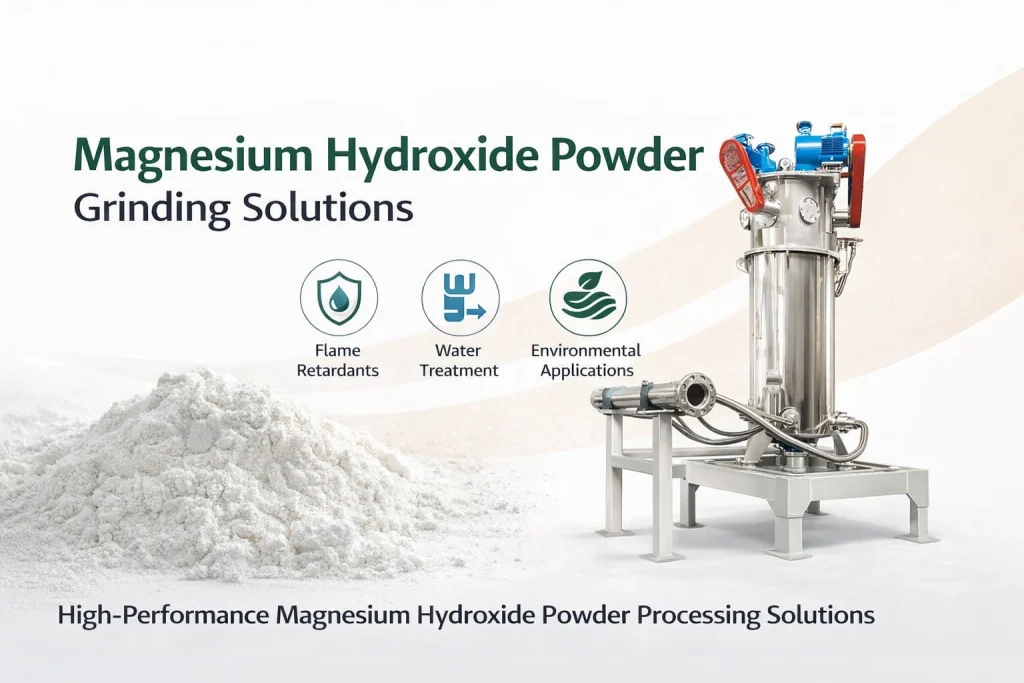
The Epic Powder MQW Jet Mill embodies this advanced grinding technology. It harnesses high-velocity gas streams to generate kinetic energy, causing particles to collide and deagglomerate efficiently. Additionally, the incorporation of a precision turbo classifier allows for dynamic and precise control of particle size.
This jet milling technology can transform raw feedstock of 325 mesh (approximately 44µm) into ultrafine powder with a D97 particle size as fine as 2.04µm, all while maintaining an impressive industrial throughput of 200 kg/h. Such performance ensures that the magnesium hydroxide meets tight specifications required for next-generation industrial applications without compromising productivity.
Common Questions
What Challenges Exist in Grinding Magnesium Hydroxide to the Ultrafine Scale?
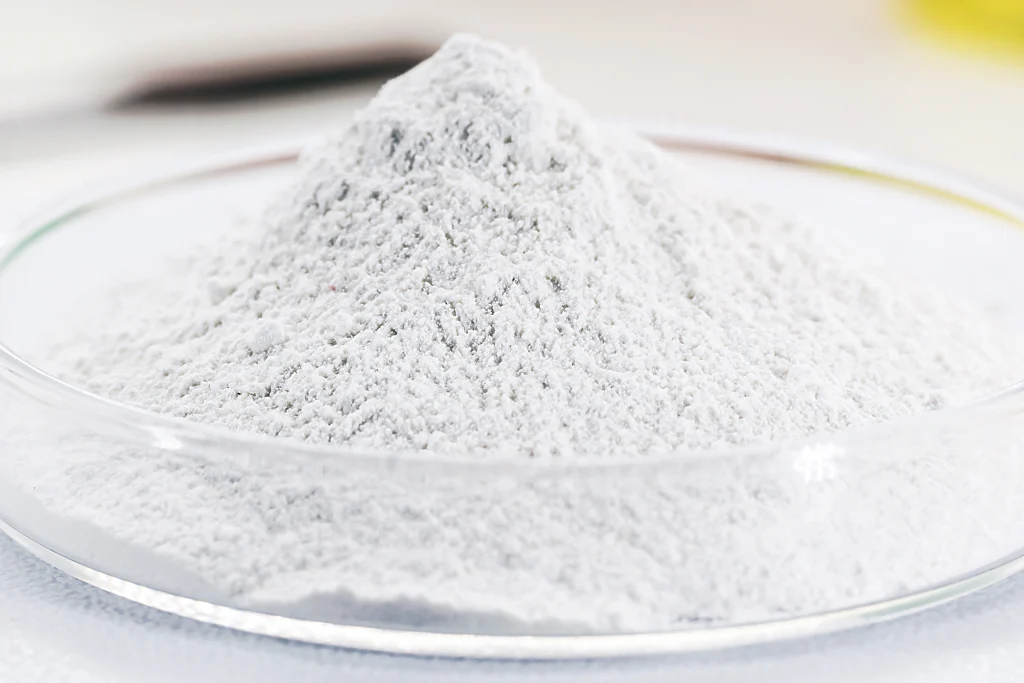
Grinding magnesium hydroxide (Mg(OH)₂) down to the ultrafine scale isn’t straightforward. Its soft nature and strong tendency to agglomerate cause traditional mechanical methods—like ball milling—to struggle. These methods often lead to low efficiency, wide particle size distribution, and the formation of “false particles” where loose clusters mimic larger particles, hurting uniformity. Additionally, magnesium hydroxide is heat sensitive, so controlling temperature rise during grinding is essential to preserve material quality. Avoiding metal contamination is another critical challenge. Impurities can spoil the product’s purity and performance, especially in sensitive industrial applications.
How Does Achieving D97 2.04μm Enhance Material Performance in End Applications?
Reaching a particle size of D97 ≤ 2.04 μm with ultrafine grinding has a direct and powerful impact on magnesium hydroxide’s performance. Smaller particles mean shorter ion diffusion paths, which is crucial for improving flame retardant efficiency by enabling faster thermal decomposition. The increased specific surface area boosts chemical reactivity, vital for acid neutralization in wastewater treatment. In polymer composites, ultrafine Mg(OH)₂ disperses nearly defect-free within the matrix, improving mechanical strength, melt processability, and the uniformity of the final product. This level of precision in particle size control significantly elevates end-use quality, whether in cables, high-performance plastics, or environmental applications.
For more details on ultrafine grinding’s impact on other materials, you can also explore our case study on the ultrafine grinding of tempered glass with MQP10 jet mill.
Benefits of Ultrafine Grinding with Epic Powder MQW Technology
Unlocked Performance in Flame Retardant Composites
Ultrafine, narrow-distribution magnesium hydroxide powders offer faster and more uniform thermal decomposition. This boosts flame retardant efficiency, shown by higher Limiting Oxygen Index (LOI) values and excellent smoke suppression. Such performance is critical for halogen-free flame retardant (HFFR) cables and premium engineering plastics, where consistent, reliable flame resistance is a must.
Enhanced Reactivity and Processability
Optimized particle size significantly increases magnesium hydroxide’s neutralization speed and efficiency in acidic wastewater, while reducing sludge volume. In polymer processing, superior dispersion of ultrafine Mg(OH)₂ improves melt flow, cuts down mold buildup, and better preserves the mechanical properties of the resin matrix, such as impact strength.
| Benefit Area | Key Improvements | Industrial Impact |
|---|---|---|
| Flame Retardance | Faster thermal breakdown, higher LOI, low smoke | Safer HFFR cables, advanced plastics |
| Wastewater Treatment | Quicker neutralization, less sludge | Cost-efficient, eco-friendly processing |
| Polymer Processing | Improved dispersion, better melt flow | Smoother molding, stronger final parts |
This combination of ultrafine grinding and precise particle control with the Epic Powder MQW Jet Mill unlocks new industrial performance levels across these sectors. For more on precision grinding technology, see our case study on ultrafine alumina grinding.
Step-by-Step Process for Ultrafine Grinding with Epic Powder MQW Jet Mill
Preparation of Magnesium Hydroxide Feedstock (325 Mesh)
Before grinding, the magnesium hydroxide feedstock, typically at 325 mesh (~44 μm), undergoes careful pretreatment. This includes thorough drying to reduce moisture and improve powder flowability, preventing clumping or bridging during feeding. The feedstock is also pre-blended to ensure uniformity, which is essential for stable, continuous operation and consistent product quality at industrial-scale throughput.
Selection and Principle of the MQW Jet Mill System
The Epic Powder MQW jet mill is the ideal choice for ultrafine grinding of magnesium hydroxide because of its unique compressed air grinding mechanism. It operates at low temperatures, preserving the thermal-sensitive Mg(OH)₂ properties. Inside, a high-precision turbine classifier dynamically controls particle size, ensuring a tight distribution and effectively preventing overgrinding. This design maximizes energy efficiency while delivering consistent superfine powders suited for demanding industrial applications. For similar ultrafine processing examples, take a look at successful cases like the silica ultra-fine grinding with MQW jet mill.
Detailed Grinding and Classification Procedure
The grinding process starts with accelerating feed particles inside the grinding chamber using high-velocity compressed air, causing particle-to-particle impacts that break down agglomerates, achieving primary particle deagglomeration. The resulting finer powder is then carried by the air stream into the classification zone. Here, the balance between centrifugal force and airflow drag allows only particles smaller than the target size (D97 ~ 2.04 μm) to pass through the classifier wheel and exit as product. Larger particles are thrown back into the grinding zone for further size reduction, creating a closed-loop system. This loop ensures tight particle size control and maximizes throughput, up to 200 kg/h industrial scale.
Post-Grinding Treatment and Quality Control
After grinding, the ultrafine magnesium hydroxide is collected using cyclonic separators to efficiently remove the powder from the airflow while minimizing product loss. The powder is then packaged in moisture-proof containers to protect its quality during storage and transport. Strict quality control follows, including laser particle size analysis to verify D97, D50, and other key metrics meet the 2.04 μm specification consistently. Additionally, scanning electron microscopy (SEM) is used to observe particle shape and dispersion quality, ensuring the powder meets performance expectations for demanding applications. This thorough process guarantees every batch delivers the superior characteristics required by high-end industries.
Practical Results of Ultrafine Grinding
Achieved Particle Size Distribution: From 325 Mesh to D97 2.04μm
Using the Epic Powder MQW jet mill, we successfully transformed magnesium hydroxide feedstock with a broad particle size distribution (325 mesh, approximately 44μm) into an ultrafine powder concentrated around a tight D97 of 2.04μm. This sharp reduction and narrowing in particle size distribution eliminate coarse tailings and “false agglomerates,” demonstrating the MQW’s precise control over grinding and classification. The result is a highly uniform powder that meets strict industrial specifications, ideal for advanced applications requiring consistent quality and performance.
Enhanced Performance in Target Applications
This ultrafine grinding breakthrough leads to significant improvements across key markets:
- Halogen-Free Flame Retardant (HFFR) cables: Smoother extrusion surfaces and a higher limiting oxygen index (LOI) improve safety and durability.
- Polypropylene flame retardant composites: Enhanced particle dispersion results in better retention of impact strength and improved mechanical properties.
- Wastewater treatment: Faster pH adjustment and precipitation speed reduce treatment time and lower sludge production, improving process efficiency.
These performance gains show how fine particle size and narrow distribution translate into tangible benefits in end-use scenarios.
Scalable and Consistent High-Volume Output (200kg/h)
The MQW jet mill not only achieves ultrafine grinding quality but does so at an industrial scale with a steady output of 200kg/h. This capacity confirms the technology as a mature, reliable production solution—not a lab-scale novelty—capable of meeting continuous, large-batch demands. Customers can depend on stable product supply and consistent performance, supporting scalable manufacturing for diverse industrial sectors.
For further insight into high-efficiency jet milling, consider exploring our case studies on ultra-fine activated carbon grinding with air classifier mill and fluidized bed jet mill operation.
Epic Powder
At Epic Powder, we offer a wide range of equipment models and tailor solutions to meet your specific needs. Our team has more than 20 years experience in various powders processing. Epic Powder is specialized in fine powder processing technology for mineral industry, chemical industry, food industry, pharama industry, etc.
Contact us today for a free consultation and customized solutions!

“Thanks for reading. I hope my article helps. Please leave a comment down below. You may also contact EPIC Powder online customer representative Zelda for any further inquiries.”
— Jason Wang, Senior Engineer