
What are jet mills?
Most generic drugs and innovative pharmaceutical products are based on poorly water-soluble active pharmaceutical ingredients (APIs). Particle size and particle size control play a critical role in the dissolution rate of pharmaceutical formulations. Jet mills, also known as air jet mills or fluid energy mills, use high-velocity air or superheated steam to cause particles to collide with one another. Through impact, friction, and shear, the material is effectively ground to an ultrafine state. Using jet mills to grind APIs can significantly improve the solubility of poorly soluble drugs. Solid dosage forms prepared from ultrafine powders can achieve dissolution performance that meets the requirements of domestic consistency evaluation. Among ultrafine grinding technologies, the jet mill is one of the most important pieces of equipment, capable of reducing materials to powders in the micrometer range.
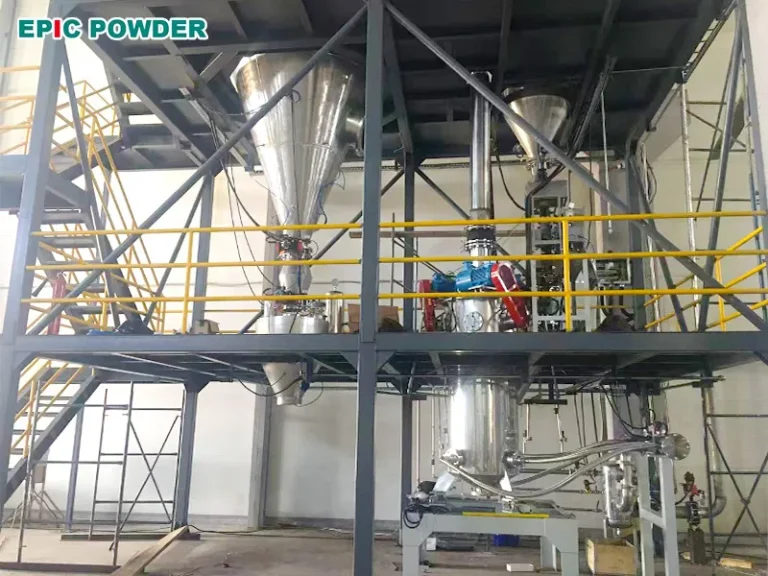
Working Principle of Jet Mills in Pharmaceutical Powder Preparation
Compressed air or inert gas is accelerated through nozzles, where the high-speed elastic airflow drives intense interactions between particles, between particles and gas, and between particles and the inner walls of the mill. These interactions include impact, shear, collision, and friction.
At the same time, centrifugal force generated by the rotating airflow, or by an integrated classifier, separates coarse and fine particles. This classification process allows only particles that meet the required size to exit the system, while oversized particles remain in the grinding zone for further size reduction.
Jet milling is a commonly used method for pharmaceutical powder preparation and is especially suitable for antibiotics, enzymes, low-melting-point materials, and heat-sensitive drugs.

Types of Jet Mills Used in Pharmaceutical Powder Processing
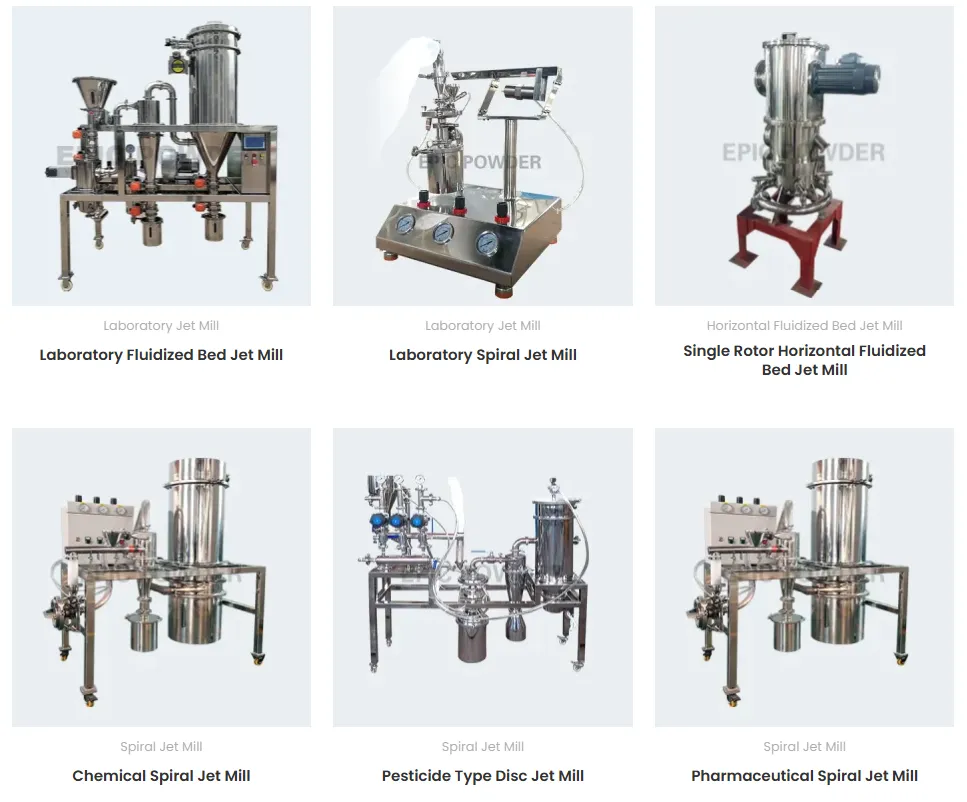
Flat-Type Jet Mill
The flat-type jet mill, also known as a disc or spiral jet mill, operates by introducing compressed air into an air distribution chamber, creating negative pressure that draws material into the mixing chamber. The material is then injected into the grinding chamber by high-speed airflow from the nozzles.
Because the nozzles are arranged at an angle to the grinding chamber radius, the material rotates at very high speed in a circular motion. Repeated collisions between particles and between particles and the chamber wall result in size reduction. Coarser particles are thrown outward by centrifugal force and continue to be ground, while fine particles are discharged and collected.
The opposed jet mill, also known as a counter-jet mill, achieves size reduction through head-on collisions of particles in a supersonic airflow. The nozzles are positioned directly opposite each other, either in pairs or in multiple opposing sets.
This design minimizes contact between particles and the chamber walls, reducing equipment wear and preventing contamination from wall materials. As a result, opposed jet mills are well suited for applications requiring high product purity.
Target-Type Jet Mill
The target-type jet mill is one of the earliest forms of jet milling technology and has relatively high energy utilization. In this design, particles accelerated by high-speed airflow impact a rigid target surface, where they are fractured.
Because the target is typically very hard, this type of jet mill is suitable for materials that are difficult to grind, relatively coarse, or possess elasticity and toughness. It is commonly used for fibrous materials and high-molecular-weight polymers. In addition to impacting the target, particles also collide repeatedly with the inner walls of the grinding chamber, resulting in high grinding intensity and output.
Circulating Tube Jet Mill
In a circulating tube jet mill, compressed gas passes through a nozzle to generate a high-speed jet. Due to negative pressure, material is automatically drawn into the mixing chamber and transported into the grinding chamber.
As the particles are accelerated, they collide with one another and with the chamber walls, leading to size reduction. During classification, coarse particles tend to move along the outer wall due to inertia, while finer particles move toward the inner wall. Fine particles are collected as product, while coarse particles return through the downcomer for further grinding.
Fluidized Bed (Opposed Jet) Mill
The fluidized bed opposed jet mill is a more recent development in jet milling technology. In this system, airflow passes through multiple nozzles to form an opposed jet flow field, causing the material to become fully fluidized.
Strong collisions, friction, and impact occur at the intersections of the jets, resulting in efficient grinding. After milling, the fine powder passes through a classifier under negative pressure. Qualified particles are collected by a cyclone separator and dust collector, while oversized particles return to the grinding zone under the influence of gravity.
Characteristics of Jet Mills in Pharmaceutical Applications
Jet mills produce powders with a narrow particle size distribution and a fine average particle size. Through high-pressure airflow and precise classification, the resulting product typically has a D50 particle size of 5–10 μm.
The powders produced have smooth surfaces and regular shapes, often approaching spherical morphology. Because mechanical wear during grinding is minimal, the product purity remains high.
Jet mills are particularly suitable for low-melting and heat-sensitive drugs. Compressed air is used as the grinding medium, and the rapid expansion of gas at the nozzle creates a cooling effect that offsets heat generated by particle collisions and friction. Temperatures inside the grinding chamber can reach tens of degrees below zero.
The system is well sealed and operates under negative pressure, resulting in high product recovery and minimal environmental impact. The enclosed process also allows for sterile or contamination-free operation.
Jet milling is a continuous process and can be combined with automated control systems, making operation straightforward. In addition, jet mills can integrate grinding, mixing, and drying in a single process. In some applications, liquids can be sprayed during milling to coat or modify particles, improving powder performance. Jet mills have therefore become one of the preferred pieces of equipment for producing high-performance ultrafine powders.
Epic Powder
EPIC POWDER is specialized in finepowder processing technology for mineral industry, chemical industry, food industry, pharma industry, etc. We are a most professional supplier of powder processing projects, especially powder milling, powder classifying, powder dispersing, powder surface treatment and waste recycling. We supply consultancy, testing, project design, machines, commissioning and training.

“Thanks for reading. I hope my article helps. Please leave a comment down below. You may also contact EPIC Powder online customer representative Zelda for any further inquiries.”
— Jason Wang, Volunteer