
PEEK (polyetheretherketone) melts at 343 degrees C and has a glass transition temperature of 143 degrees C. Neither of those numbers is the relevant threshold for grinding. The relevant threshold is around 80-100 degrees C: the point at which localised softening begins at particle contact surfaces under mechanical stress. Hit that threshold during grinding and the particles weld to each other rather than fracturing. The result is agglomerates, a broad particle size distribution, and a material that no longer flows the way a fine polymer powder needs to for laser sintering or composite processing.
Traditional mechanical grinding like ball mills, hammer mills and pin mills generates heat through friction and impact. For calcium carbonate or quartz, that heat is manageable. For PEEK, it is the primary failure mode. This is why jet milling is the technology of choice for producing ultrafine PEEK powder. The grinding mechanism is particle-on-particle collision driven by high-velocity gas jets, not metal-to-metal impact. The expanding gas cools as it exits the nozzles. The grinding zone stays cold. PEEK fractures cleanly rather than softening.
This article covers how jet milling works for high-performance polymers specifically, how to set parameters for PEEK, what particle size targets are achievable and realistic for each application, and how the technology compares to alternatives including cryogenic grinding. EPIC Powder Machinery supplies fluidised bed jet mills for PEEK, PTFE, polyimide, and other engineering polymer applications.
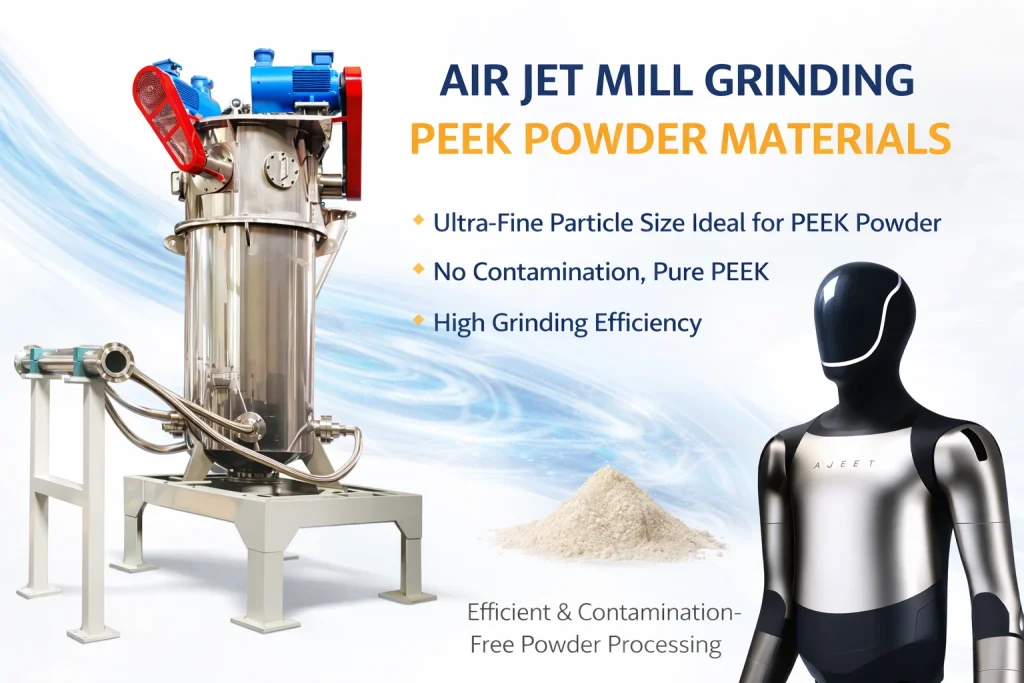
Why PEEK Is Difficult to Grind — and Where Conventional Mills Fail
Most hard materials — minerals, ceramics, metals — are brittle in the sense that they fracture under impact loading without significant plastic deformation. Applying stress above the yield point causes crack propagation, which reduces particle size. PEEK is not like this. It is a semicrystalline thermoplastic: it has both amorphous regions that are viscoelastic and crystalline regions that are harder and more brittle. Under mechanical impact, the amorphous regions absorb energy through plastic deformation rather than fracturing. The result is that PEEK dissipates grinding energy rather than converting it to new particle surfaces.
Three specific problems appear when PEEK is ground in conventional mechanical mills:
- Heat-induced agglomeration: the energy that fails to fracture the particles converts to heat at the contact point. Localised surface temperatures well above ambient develop during high-speed impact. Softened particle surfaces weld together, creating agglomerates that are larger than the original feed — the mill is making the powder coarser, not finer.
- Metal contamination: PEEK is used in medical implants, aerospace structures, and semiconductor components where metal ion contamination at the ppm level matters. Steel or hardened iron grinding surfaces wear measurably when processing tough polymers. The contamination may be acceptable for industrial fillers but is not acceptable for medical or electronic-grade PEEK powder.
- Broad, uncontrollable PSD: because some fraction of the PEEK feed agglomerates rather than fracturing, the particle size distribution widens progressively during grinding. The D97 climbs while the D50 moves only slowly finer. The result is a product that does not meet the tight PSD specifications required for laser sintering or implant manufacturing.
How Jet Milling Solves the PEEK Grinding Problem
The Joule-Thomson Effect: Why the Grinding Zone Stays Cold
In a fluidised bed jet mill, compressed gas (air or nitrogen) is fed to nozzles at 4-8 bar and accelerates to supersonic velocity as it exits. When a high-pressure gas expands rapidly through a nozzle, it cools — this is the Joule-Thomson effect. At the grinding pressures used for PEEK, the gas temperature at the nozzle exit drops to 0 to -20 degrees C. The grinding zone, maintained by a continuous flow of this cold gas, stays well below the temperature at which PEEK surfaces begin to soften.
The practical consequence: PEEK particles collide at high velocity and fracture rather than deforming. The cold grinding zone also prevents agglomeration — particles that are already fine and have a tendency to stick at elevated temperature remain separate in the cold, turbulent gas stream. The product PSD is tighter than anything achievable with ambient-temperature mechanical grinding of the same material.
Particle-on-Particle Grinding: Zero Metal Contact
The size reduction mechanism in a jet mill is purely particle-on-particle collision. The gas jets accelerate PEEK particles into converging streams where they collide with each other. The only solid surfaces in contact with the product are the mill chamber wall, the classifier wheel, and the nozzle assembly — none of which are in the high-energy collision zone. In a ceramic-lined configuration, there is no metal contact with the product at any point in the circuit.
For medical-grade PEEK powder — which will eventually be implanted in a patient or used in an interventional device — the absence of metal contamination is not optional. The biocompatibility of PEEK depends on the absence of Fe, Cr, Ni, and other metal ions that ceramic or polymer-lined jet mill surfaces simply do not introduce.
Integrated Classification: D97 and D50 Are Both Controllable
A fluidised bed jet mill has a built-in dynamic classifier wheel. Fine particles that meet the size specification pass through the wheel and exit to the product collection system. Oversized particles are centrifuged back into the grinding zone. The classifier wheel speed is the primary control variable for D50 — higher speed produces a finer product. Grinding gas pressure and feed rate are secondary variables that affect throughput and the shape of the distribution.
This closed-loop design means PEEK powder does not accumulate residence time in the mill beyond what is needed to reach the target size. Particles exit as soon as they are fine enough. There is no progressive heat buildup from extended grinding, and no particles are over-ground because the classification step removes them immediately once they reach specification.
Particle Size Requirements by Application — What Is Actually Achievable
The original outline contained a factual error worth addressing directly: it described a D50 of ~45 μm as ‘ultrafine’ for laser sintering, while also defining ultrafine as below 10 μm in the same article. These are different applications requiring different particle sizes. The table below maps the correct specifications.
| Aplikasi | Typical D50 Target | Typical D97 Target | Why This Particle Size |
| Laser sintering / SLS 3D printing | 45-90 um | <120 um | Powder must flow and pack uniformly in the powder bed; too fine causes poor flowability |
| Polymer composite impregnation | 5-15 um | <30 um | Fine powder improves fibre wetting and void reduction in prepreg and filament winding processes |
| Coatings and surface treatments | 3-10 um | <20 um | Fine particle size improves coating adhesion and reduces surface roughness |
| Medical implant manufacturing | 1-5 um | <15 um | Fine powder allows near-net-shape pressing; surface area supports bioactive molecule grafting |
| Tribological additives (lubricant filler) | 1-5 um | <10 um | Ultrafine powder disperses in lubricant or polymer matrix without agglomeration |
| Membrane and filtration components | <3 um | <8 um | Fine, uniform powder enables controlled porosity in sintered PEEK membrane structures |
Note: laser sintering PEEK powder (D50 45-90 um) is typically produced by cryogenic grinding or dissolution-precipitation rather than jet milling. Jet milling is the technology of choice for fine and ultrafine PEEK (D50 below 15 um). The appropriate technology depends on the application’s particle size requirement.
Jet Milling vs. Cryogenic Grinding vs. Mechanical Milling for PEEK
Three technologies are used commercially to produce PEEK powder. Each has a particle size range where it is the optimal choice. Understanding the trade-offs helps you select the right process for your specific application.
| Faktor | Penggilingan Jet | Cryogenic Grinding | Mechanical Milling (Ambient) |
| D50 terbaik yang bisa dicapai | 0.5-5 um (practical lower limit) | 20-60 um | 30-100 um (with agglomeration problems) |
| Best D50 range for PEEK | 1-15 um | 40-100 um (SLS powder range) | Not recommended for PEEK |
| Thermal degradation risk | None (gas expansion cooling) | None (LN2 embrittlement) | High (localised heating at impact) |
| Risiko kontaminasi logam | Near zero (ceramic contact surfaces) | Low-medium (steel mill surfaces at low temp) | High (steel wear at elevated heat) |
| PSD control | Excellent (adjustable classifier) | Moderate (screen-based separation) | Poor (agglomeration distorts distribution) |
| Particle morphology | Angular to semi-spherical | Irregular, often lamellar fracture | Irregular, often elongated |
| Operating cost per tonne | High (compressed gas energy) | Medium-high (LN2 consumption) | Low (but product quality limits applicability) |
| Best for | Medical, composites, coatings (D50 <15 um) | SLS 3D printing powder (D50 40-90 um) | Industrial-grade, non-critical applications only |
Operating Parameters for PEEK on a Fluidised Bed Jet Mill
PEEK behaves differently from mineral materials in the jet mill because its density is much lower (1.26-1.32 g/cm3 vs. 2.7 g/cm3 for alumina) and its toughness resists fracture until sufficient collision energy is applied. The following parameter ranges are starting points for PEEK on a standard fluidised bed jet mill — confirm with a test grind on your specific grade.
| Parameter | Typical Range for PEEK | Effect on Product | Catatan |
| Tekanan gas penggilingan | 5-8 bar | Higher pressure increases particle collision velocity — critical for tough polymers. Below 5 bar, PEEK does not fracture efficiently. | Start at 6 bar and adjust based on PSD results |
| Kecepatan roda pengklasifikasi | 2,000-8,000 rpm (mill-size dependent) | Primary D50 control. Higher speed = finer product. | Increase in 500 rpm steps; sample and measure PSD after each change |
| Tingkat umpan | Low to moderate (well below mineral feed rates for equivalent mill size) | Higher feed rate increases particle concentration, slightly coarsens cut point. PEEK feed rate should be 40-60% of equivalent mineral feed rate. | Use a controlled vibratory or screw feeder; inconsistent feed rate widens PSD |
| Gas type | Dry compressed air (standard); nitrogen (medical/aerospace grade) | Nitrogen prevents oxidation of polymer surface at grinding conditions. Required for medical-grade applications. | Monitor gas dew point — moisture causes electrostatic agglomeration of fine PEEK powder |
| Ukuran pakan | Typically <3 mm pellets or pre-granulated PEEK | Coarser feed increases grinding load; very fine feed can cause bridging in the feed system | Pre-grind to 1-3 mm if starting from larger pellets |
Production Applications: What Jet-Milled PEEK Achieves
APPLICATION 1
PEEK Micropowder for Spinal Implant Manufacturing — D50 3.5 μm, Zero Metal Contamination
PersyaratanA medical device manufacturer producing PEEK spinal interbody fusion cages needed a fine PEEK powder for a polymer-sintering process used to create porous scaffold structures that promote bone ingrowth. The specification was D50 3-5 um, D97 below 12 um, and Fe below 0.5 ppm — the same contamination level required for implant-grade titanium powder. Their previous supplier was using a pin mill and consistently failing the Fe specification at 2-4 ppm.
SolusinyaEPIC Powder Machinery configured a fluidised bed jet mill with full ceramic contact surfaces (ZrO2 classifier wheel and housing liners, Al2O3 nozzle inserts) operating in a closed nitrogen loop. Nitrogen purity was maintained at 99.9%. Grinding pressure was set at 6.5 bar; classifier speed at 5,800 rpm for the D50 3.5 um target.
Hasil
D50: 3.4 um, D97 11.2 um — within specification on every production batch
Fe contamination: below 0.15 ppm by ICP-MS — 10-20x lower than the pin mill process
Polymer integrity: DSC (differential scanning calorimetry) confirmed no change in melting point or crystallinity vs. reference unground PEEK — no thermal degradation
Regulatory documentation: full material traceability from raw PEEK pellet batch through to finished powder lot; COA with PSD, ICP-MS, and DSC supplied with every shipment
APPLICATION 2
PEEK Composite Powder for Aerospace Carbon Fibre Prepreg — D50 8 μm
Persyaratan
An aerospace composite manufacturer was developing PEEK/carbon fibre prepreg for structural aircraft components. Fine PEEK powder is dispersed onto carbon fibre tows before consolidation; the powder melts during consolidation and forms the matrix. Finer PEEK powder improves distribution uniformity on the fibre surface and reduces void content in the consolidated laminate. Their target was D50 6-10 um with D97 below 25 um. Previous mechanical grinding attempts produced D97 above 45 um with visible agglomerates.
Solusinya A fluidised bed jet mill in dry compressed air (aerospace-grade PEEK does not require nitrogen atmosphere) with classifier set at 3,400 rpm and grinding pressure at 7 bar.
Hasil
D50: 8.1 um, D97 23 um — meeting the specification with margin
Agglomerates: none detected by microscopy above 30 um — the problem that had made mechanical grinding unsuitable was eliminated
Composite void content: reduced from 1.8% (with mechanical-ground PEEK powder) to 0.6% in consolidation trials — within the aerospace requirement of below 1%
Kapasitas: 12 kg/h on a mid-range mill size — sufficient for pilot production volume
Other High-Performance Polymers Suitable for Jet Milling
PEEK is the most commonly discussed high-performance polymer for jet milling, but the same principles apply to the broader family of engineering polymers. The key characteristic shared by all of them: they are tough, heat-sensitive, and used in applications where metal contamination and thermal degradation are unacceptable.
| Polymer | Softening Concern | Typical Jet Mill D50 Target | Key Applications |
| PTFE | Does not melt conventionally but creeps under stress above 19 degrees C — ambient grinding causes creep and agglomeration | 1-5 um | Lubricant additives, non-stick coatings, medical seals |
| Polyimide (PI) | High Tg (250-400 degrees C) — less sensitive than PEEK but still benefits from cold grinding for fine grades | 2-8 um | Aerospace film, flexible circuits, high-temp bushings |
| PPS (polyphenylene sulfide) | Tg 85-90 degrees C — grinding above ambient temperature causes significant agglomeration | 3-10 um | Automotive, chemical-resistant components, electronics |
| PEKK | Similar to PEEK, Tg ~165 degrees C, used where higher crystallisation rate is needed | 2-8 um | Aerospace composites, 3D printing, implants |
| UHMWPE | Very low softening point — even frictional heat causes surface welding; requires cold gas or cryogenic assist | 5-15 um | Orthopaedic implants, wear parts, ballistic protection |
| Processing PEEK or Another High-Performance Polymer? EPIC Powder Machinery’s fluidised bed jet mills are configured for PEEK, PTFE, PI, PPS, and other engineering polymers. We offer free test grinds on your material — you specify the target D50 and D97 and we return PSD data, contamination analysis, and a process parameter recommendation. For medical and aerospace grades, we can run under nitrogen with ceramic contact surfaces and supply full material traceability documentation.Send us your material, your target PSD, and your application and we will design the right configuration. Minta Uji Coba Penggilingan Gratis: www.jet-mills.com/contact Explore Our Polymer Jet Mill Range: www.jet-mills.com |
Pertanyaan yang Sering Diajukan
What D50 is achievable by jet milling PEEK, and is there a practical lower limit?
The practical lower limit for jet milling PEEK under standard conditions is approximately D50 1-2 um. Below this size, PEEK powder becomes increasingly prone to electrostatic agglomeration in the classifier zone — fine polymer particles carry surface charge, and at high specific surface area they attract each other more strongly than the classifier airflow can separate them. Some producers use anti-static additives or humidity control in the gas stream to push below 1 um, but this adds process complexity. For most practical applications, the achievable range is D50 1.5-15 um, with D97 typically 3-4 times the D50. If your application requires coarser PEEK powder for laser sintering (D50 40-90 um), jet milling is not the right technology for that range — cryogenic grinding or dissolution-precipitation are better suited and more cost-effective.
Does jet milling change PEEK’s molecular weight or crystallinity?
At correctly controlled operating parameters, no — and this is confirmed by two standard characterisation tests. DSC (differential scanning calorimetry) measures the melting point and crystallinity of the powder: if thermal degradation has occurred during grinding, the melting peak shifts or broadens and the crystallinity changes. GPC (gel permeation chromatography) measures molecular weight distribution: chain scission from thermal or mechanical degradation shows up as a shift to lower molecular weight. Jet-milled PEEK produced at correct grinding pressure and temperature consistently shows DSC and GPC results equivalent to the unground resin reference. The risk of molecular weight change is real if grinding pressure is set too high (excessive impact energy) or if moisture enters the nitrogen circuit (hydrolytic degradation of the ester linkages in PEEK). Validating with DSC on the first production lot is standard practice for medical-grade applications.
When should I use nitrogen instead of compressed air for jet milling PEEK?
Nitrogen is required for two scenarios. First, medical and implant applications: even trace oxidation of the PEEK surface during grinding can affect biocompatibility. Nitrogen eliminates oxygen from the grinding atmosphere entirely, preventing oxidative modification of the polymer surface chemistry. Second, any application where the PEEK powder will be used in an oxygen-sensitive downstream process, such as certain composite consolidation routes or surface functionalisation steps. Compressed air is acceptable for aerospace structural composites, tribological additives, and general industrial applications where a small degree of surface oxidation has no functional consequence. The operating cost difference between air and nitrogen is significant for continuous production — nitrogen requires either on-site generation or bulk supply, and the closed-loop nitrogen system adds capital cost. Use nitrogen when your application specification requires it, not by default.
How does the particle morphology of jet-milled PEEK compare to cryogenically ground PEEK?
Cryogenic grinding embrittles PEEK by cooling it below its glass transition temperature with liquid nitrogen before the grinding stage. At cryogenic temperatures, the amorphous regions of PEEK lose their viscoelastic character and become brittle — the material fractures more like a ceramic. Cryogenic grinding of PEEK typically produces irregular, lamellar particles because PEEK tends to cleave along the plane of its semicrystalline lamellae when brittle. Jet milling produces more equiaxed, angular particles because the fracture is driven by high-velocity impact rather than cleavage. Neither process produces the spherical particles that dissolution-precipitation can achieve. Particle morphology matters for applications where powder flowability is critical — SLS 3D printing, for example, favours more rounded particles because they flow and pack more uniformly in the powder bed. For composite impregnation and medical applications, angular particles from jet milling are acceptable and in some cases preferred because the higher surface roughness improves bonding.
Can EPIC Powder Machinery’s jet mills process other high-performance polymers besides PEEK?
Yes. EPIC Powder’s fluidised bed jet mills have been used for PTFE, polyimide (PI), PPS, PEKK, UHMWPE, and several other engineering polymers. The configuration adjustments for different polymers are primarily in grinding pressure (PTFE requires lower pressure than PEEK due to its very different fracture behaviour), nitrogen atmosphere (required for PTFE and UHMWPE to prevent oxidation, as for medical PEEK), and classifier speed (varies with target D50 and polymer density). UHMWPE, with its extremely low softening point, sometimes benefits from mild pre-cooling of the feed material before the jet mill. We offer test grinds on each polymer grade before equipment specification — polymer milling behaviour is more variable between grades of the same base material than mineral milling, so a trial on your specific resin is the only reliable way to establish the production parameter set.
Bubuk Epik
Bubuk Epik, 20+ years of experience in the ultrafine powder industry. Actively promote the future development of ultra-fine powder, focusing on crushing, grinding, classifying and modification process of ultra-fine powder. Contact us for a free consultation and customized solutions! Our expert team is dedicated to providing high-quality products and services to maximize the value of your powder processing. Epic Powder—Your Trusted Powder Processing Expert!

“Thanks for reading. I hope my article helps. Please leave a comment down below. You may also contact EPIC Powder online customer representative Zelda untuk pertanyaan lebih lanjut.”
— Jason Wang, Insinyur