
Understanding the Feedstock: Key Properties of Carbon Precursors
Green Coke
Green coke, a primary carbon precursor, is characterized by a relatively high volatile matter content. This volatile composition impacts its milling behavior significantly. Due to its softer and more porous nature, green coke grinds more easily in jet mills, enabling efficient size reduction to ultra-fine particles. However, the variable volatile content requires careful control during jet milling to avoid agglomeration and ensure consistent D50 1µm particle size.
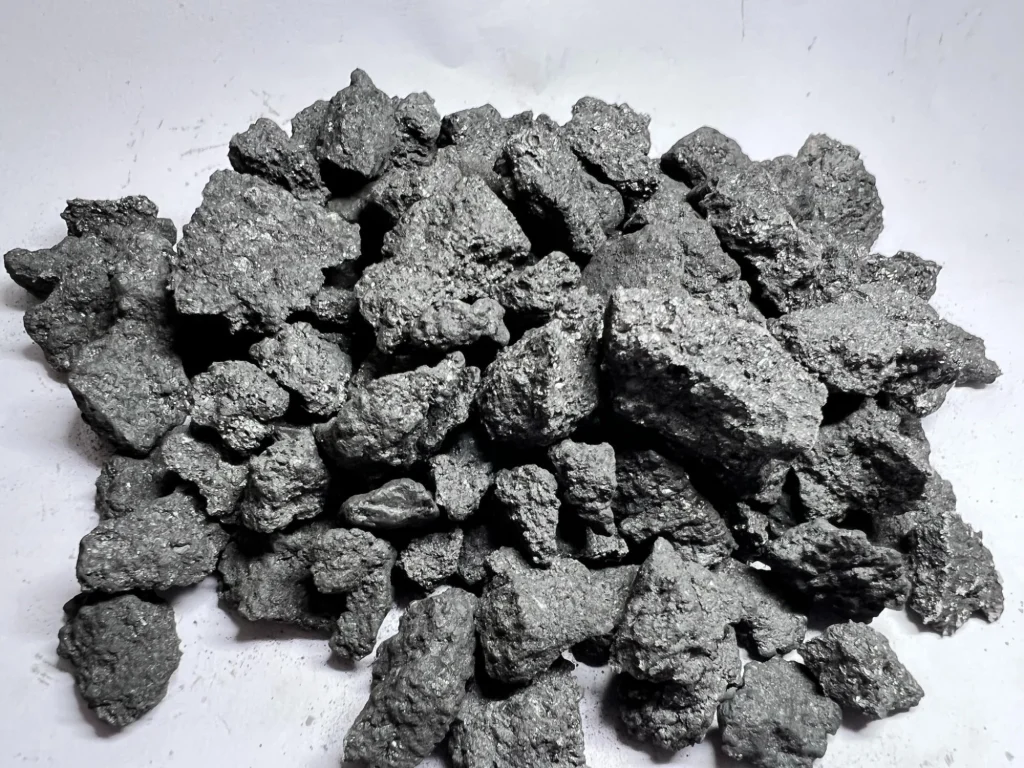
Calcined Coke
Calcined coke undergoes heat treatment to remove volatiles, resulting in a harder and denser material. Its increased hardness presents challenges in ultra-fine grinding, demanding robust jet mill designs resistant to abrasion. Milling calcined coke to achieve a uniform D50 1µm or 4–5µm particle size requires optimized parameters to maintain equipment longevity while delivering consistent, contamination-free micronized powder.
Needle Coke
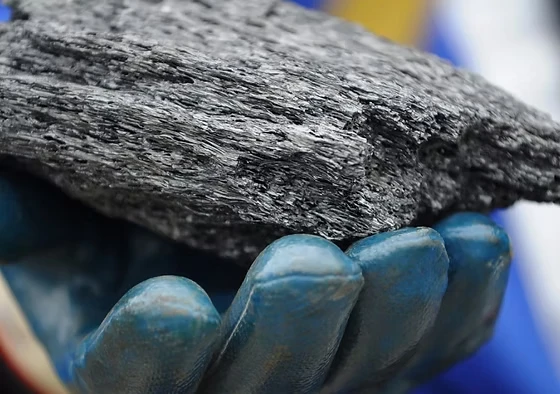
Needle coke stands out with its highly crystalline structure, imparting excellent electrical conductivity and mechanical strength—key traits for lithium-ion battery anodes. Despite its crystalline nature, needle coke exhibits favorable grindability due to its fibrous morphology. Jet milling can rapidly produce tight particle size distributions, typically around D50 4–5µm, catering to premium EV battery applications where particle uniformity and purity are critical.
Pitch Coke
Pitch coke, derived from carbonized pitch, features an amorphous structure that affects its milling characteristics uniquely. Its softer texture allows for relatively easy micronization, though the sticky nature of pitch components can lead to challenges like powder agglomeration. Jet mills can overcome these issues through precise control of fluid energy and classification, enabling the production of fine powders without compromising product integrity or introducing contamination.
Why Particle Size Matters in Lithium-Ion Battery Anodes
The Relationship Between D50 and Electrochemical Performance
Particle size, especially the median size or D50, plays a crucial role in the electrochemical performance of lithium-ion battery anodes. Smaller particles provide a larger surface area, enhancing lithium-ion intercalation and improving battery efficiency. However, balancing this with structural stability is key—too fine a powder can affect packing density and electron pathways.
D50 1µm: Maximizing Energy Density and Rate Capability
Achieving a D50 of 1µm in materials like green coke or needle coke is vital for maximizing energy density and rate capability. Ultra-fine particles deliver better contact between the active material and electrolyte, reducing diffusion distances and boosting charge/discharge speeds. This micronization level supports the development of high-performance batteries, particularly for electric vehicles needing rapid power delivery.
D50 4-5µm: Optimizing Slurry Stability and Coating Quality
In contrast, a D50 particle size of 4-5µm strikes a good balance for slurry stability and coating quality during electrode fabrication. Slightly larger particles improve suspension uniformity, making the slurry easier to handle and apply as a consistent, defect-free coating. This particle size also helps prevent excessive agglomeration that can compromise electrode integrity.
The Importance of Contamination-Free Grinding
Contamination-free grinding is essential when milling carbon materials for lithium-ion battery anodes. Any metallic or abrasive contamination can degrade battery performance and cause defects. Jet mills offer a clean grinding method—no moving parts and use of inert air prevent contamination. This ensures that the ultra-fine grinding to D50 1µm or controlled milling to 4-5µm is achieved with pure feedstock, maintaining the integrity of the final battery anode material.
For detailed insights into clean milling processes for battery materials, companies often rely on advanced jet mill technologies demonstrated in projects like the production line of lithium iron phosphate grinding mill for electric vehicles, which underline the importance of particle size control combined with contamination-free processing.
Jet Mill Technology for Carbon Material Micronization
How Spiral Jet Mills Work: Fluid Energy and Self-Collision
Spiral jet mills use high-speed jets of compressed air or gas to grind carbon materials like petroleum coke and needle coke down to ultra-fine particles. The feedstock is fed into a circular milling chamber where it’s accelerated by these jets in a spiral pattern. The particles collide with each other at high velocity, breaking down into finer sizes without any mechanical impact from moving parts. This fluid energy and self-collision mechanism makes spiral jet mills ideal for producing powders with a D50 around 1µm.
Key Advantages: No Heat Generation, No Moving Parts, No Contamination
One of the biggest benefits of jet mill technology for carbon grinding is the lack of heat generation. Since the process relies on air or gas flow rather than friction, the material doesn’t overheat, preserving its chemical and physical properties. Plus, jet mills have no rotating or grinding parts, which drastically lowers wear and contamination risks. This is critical when targeting contamination-free ultra-fine powders, especially for sensitive applications like lithium-ion battery anodes.
Achieving Tight Particle Size Distributions in the 1-5 Micron Range
Spiral jet mills are highly effective at producing very narrow particle size distributions, typically between 1 and 5 microns. Precision classification systems inside the mill allow operators to adjust parameters like feed rate, grinding pressure, and classifier speed, ensuring the powder meets exact D50 targets. This tight control over particle size distribution improves consistency, boosts performance, and simplifies downstream processing. For more insights into similar jet milling applications, see our case study on the spiral jet mill production of API materials.
D50 1µm Green Coke for High-Energy Density Anodes
Customer Requirement: Consistent D50 1 micron from High-Volatile Green Coke
A leading battery materials manufacturer needed ultra-fine green coke powder with a strict particle size target of D50 1µm. Their high-volatile green coke feedstock posed milling challenges due to its variable moisture and volatile content, which can affect grinding consistency and product quality. The goal was to deliver uniform micronized powder ideal for high-energy density lithium-ion battery anodes, without compromising purity.
Solution: Optimized Spiral Jet Mill with Precision Classification
To meet this, we deployed a spiral jet mill configured for high-energy fluid grinding combined with a precision classifier system. This setup leverages fluid energy to achieve intense particle self-collision, producing ultra-fine particles with minimal overgrinding. The classifier precisely separates particles, maintaining a tight D50 around 1µm and controlling fines generation. Our mill design ensures no heat build-up, protecting the green coke’s integrity through the process. For deeper insights into jet mill advantages for carbon materials, see our example of a petroleum coke grinding jet mill project in Sichuan.
Result: Successful Micronization with Zero Iron Contamination
The optimized process delivered consistent D50 1µm green coke powder that met the customer’s strict specifications. Importantly, the use of non-metallic mill linings and pure compressed air prevented iron contamination—critical for battery anode performance. This zero contamination status assured the powder’s quality and reliability in advanced electrochemical applications. Overall, the project demonstrated how tailored jet mill technology can transform challenging carbon precursors into high-value materials for next-gen batteries.
D50 4-5µm Needle Coke for Premium EV Battery Applications
Challenge: Producing Needle Coke Powder at D50 4-5µm with Minimal Fines
Needle coke, prized for its high crystallinity and conductivity, is essential in premium EV battery anodes. The challenge was to achieve a tight particle size around D50 4-5µm while minimizing fines below 1µm, which can destabilize slurry and reduce coating quality. Controlling the grind without introducing contamination or excessive heat was critical to meet automotive-grade standards.
Solution: Jet Mill Configuration for Controlled Particle Size Distribution
We tailored the jet mill setup specifically to balance grinding energy and classification speed. Key adjustments included:
| Parameter | Adjustment Description |
|---|---|
| Grinding Pressure | Optimized to reduce over-grinding and fines |
| Classifier Speed | Fine-tuned to ensure a narrow particle range |
| Feed Rate | Controlled for consistent throughput |
| Material Flow Path | Designed to minimize particle collision damage |
This specialized configuration allowed precise control over particle size distribution, resulting in a powder perfectly suited for EV battery anodes with consistent flow and coating behavior. No contamination was introduced thanks to ceramic mill linings and clean air sources, maintaining material purity.
Result: Consistent Product Quality Meeting Strict Automotive Specifications
The final output achieved:
- D50 consistently within 4-5µm with less than 5% fines below 1µm
- Homogeneous particle shape and size distribution
- Zero metal contamination verified by quality control
- Superior batch-to-batch reproducibility
This met all strict specs for premium EV battery manufacturers, supporting reliable high-performance anode materials. The success highlights how jet milling technology offers unmatched control for advanced carbon material micronization. For more insight on precision grinding, see our experience with challenging powders like progesterone production line with disc jet mill.
Process Optimization and Quality Control
Key Parameters: Grinding Pressure, Feed Rate, and Classification Speed
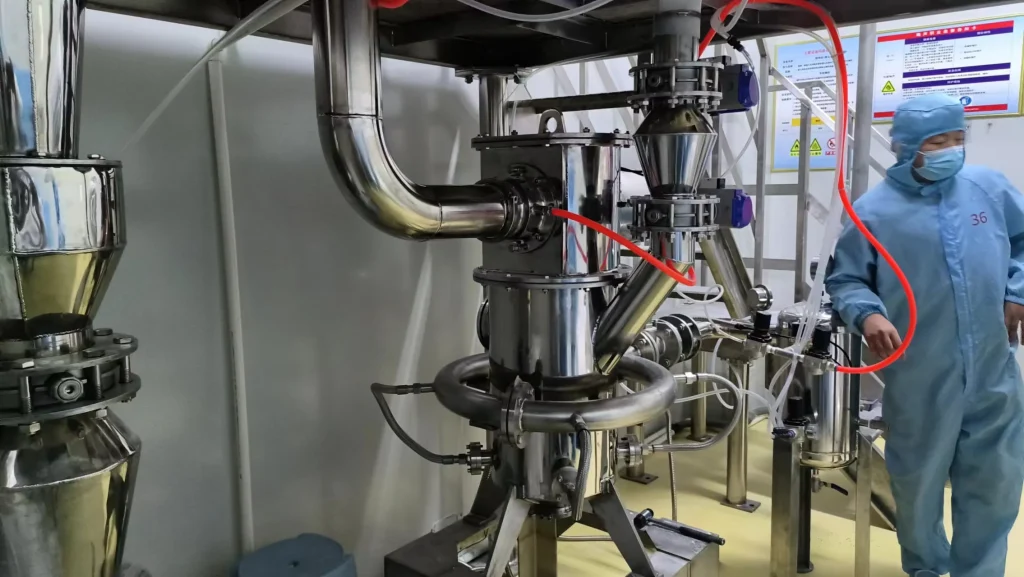
Optimizing jet mill grinding of petroleum and needle coke to D50 1µm depends mainly on controlling three parameters:
| Parameter | Effect on Particle Size and Quality |
|---|---|
| Grinding Pressure | Higher pressure increases collision energy, producing finer particles but can raise wear |
| Feed Rate | Too high feed rate causes coarse particles; slower feed ensures uniform grinding |
| Classification Speed | Faster classifier removes finer particles, tightening size distribution |
Balancing these parameters ensures stable production and consistent ultra-fine particle sizes.
In-Process Particle Size Monitoring for Consistent Results
Real-time particle size analysis during milling is crucial. Using laser diffraction or dynamic light scattering devices helps:
- Detect deviations from the target D50 1µm
- Adjust classifier speed or feed rate on the fly
- Avoid wide size distributions and minimize fines or oversize particles
This active monitoring is key to maintaining tight particle size distributions essential for lithium-ion battery anode materials.
Preventing Contamination: Ceramic Linings and Pure Air Sources
Keeping the carbon feedstock free from metal contamination requires stringent contamination control:
- Ceramic Linings: Replace metal parts contacting the powder to avoid iron or steel contamination during grinding.
- Pure Air Sources: Use filtered, oil-free compressed air to prevent introducing impurities.
- System design with no moving mechanical parts in the grinding zone also reduces contamination risk.
These practices ensure ultra-fine powders maintain chemical purity required for premium battery applications.
For detailed insights on contamination-free milling solutions, see our case studies on ultra-fine activated carbon grinding with air classifier mill.
Why Epic Powder for Your Carbon Grinding Needs?
Extensive Experience with Diverse Carbon Feedstocks
At Epic Powder, we understand that each carbon precursor—be it green coke, needle coke, or pitch coke—has its own unique properties that affect how it grinds. Our team brings years of hands-on experience working with a wide range of carbon materials, ensuring we tailor our jet mill processes to achieve ultra-fine grinding results consistently. Whether you need to reach a D50 of 1µm for high-performance battery anodes or control particle size between 4-5µm for slurry stability, we’ve seen it and perfected it.
Flexible Equipment Configurations for Multiple D50 Targets
Every project has its distinct particle size requirements, and Epic Powder’s jet mill systems are engineered for flexibility. We provide customized equipment setups—from spiral jet mills optimized for fine particle fluid energy milling to precision classifiers that ensure tight size distribution. This means you can rely on us to meet strict specifications, whether you’re targeting the ultra-fine D50 1µm range for energy-dense lithium-ion battery anodes or slightly coarser sizes that balance ease of handling and performance.
Engineering Support for Process Optimization and Scale-Up
Successful carbon grinding goes beyond equipment—process optimization and quality control are key. Our engineering team works closely with you to optimize grinding parameters like feed rate, air pressure, and classification speed. Plus, we assist with scaling from lab trials to full production while maintaining contamination-free, high-quality powders. For detailed insights into our tailored grinding solutions, check out how Epic Powder empowered 3M’s advanced resin production with precise customization.
When you need reliable, contamination-free ultra-fine grinding of petroleum and needle coke, Epic Powder’s expertise and flexible jet mill technology deliver consistent, top-quality carbon powders designed for today’s demanding markets.
Frequently Asked Questions (FAQ)
What is the difference between grinding green coke and calcined coke in a jet mill?
Green coke contains higher volatile matter and tends to be softer, which makes it somewhat easier to grind but more prone to agglomeration. Calcined coke, on the other hand, is much harder and more abrasive due to heat treatment, requiring more robust jet milling parameters to achieve the desired ultra-fine particle size without excessive wear. Adjusting feed rates and grinding pressure helps optimize milling performance for each type while maintaining consistent particle size distribution.
Can the same jet mill achieve both D50 1µm and D50 4-5µm consistently?
Yes, with the right configuration and precise classification control, a single spiral jet mill can reliably produce powders at both D50 1µm and D50 4-5µm. Key factors include adjustable grinding pressure, classifier speed, and feed rate to tailor the particle size distribution for specific applications like lithium-ion battery anodes or premium EV battery-grade needle coke. This flexibility makes jet mills ideal for diverse carbon feedstocks and micronization targets.
How does jet milling compare to mechanical milling for carbon materials?
Jet milling uses high-velocity air streams to create particle collisions, grinding materials without heat generation or mechanical contact. This avoids contamination, preserves material purity, and produces narrow particle size distributions down to the 1-micron range. Mechanical milling often involves grinding media and moving parts, which can introduce contamination and inconsistent particle sizes, especially for sensitive carbon materials like petroleum coke and needle coke.
What measures are taken to prevent metal contamination during grinding?
To prevent metal contamination in jet milling, equipment components in contact with the material are often lined with ceramics or wear-resistant coatings. Pure, oil-free compressed air is used to avoid introducing impurities. Additionally, the absence of traditional grinding media eliminates rust or metal debris risks. These design choices guarantee ultra-clean, high-purity carbon powders suitable for demanding applications such as lithium-ion batteries. For more details on contamination prevention, see our case study on ultra-fine grinding with MQW series jet mills.
Epic Powder
Epic Powder, 20+ years of work experience in the ultrafine powder industry. Actively promote the future development of ultra-fine powder, focusing on crushing, grinding, classifying and modification process of ultra-fine powder. Contact us for a free consultation and customized solutions! Our expert team is dedicated to providing high-quality products and services to maximize the value of your powder processing. Epic Powder—Your Trusted Powder Processing Expert!
“Thanks for reading. I hope my article helps. Please leave a comment down below. You may also contact EPIC Powder online customer representative Zelda for any further inquiries.”
— Emily Chen, Engineer