
In fields such as nanotechnology, materials science, drug delivery, and environmental science, we often work with minute particles. The properties of these particles are frequently determined not just by their chemical composition, but more importantly, by their form of existence. Among these, primary particles and secondary agglomerates are two of the most fundamental and critical concepts. Accurately distinguishing between them is the cornerstone for understanding material performance, optimizing preparation processes, and even assessing their safety. This article will systematically explain the definitions and differences between primary particles and secondary agglomerates, and provide a detailed introduction to several commonly used methods for their differentiation.

I. Definitions
A primary particle refers to the smallest independent, discrete unit with a regular or irregular geometric shape, formed through nucleation and growth within a specific reaction system (such as combustion, precipitation, or vapor-phase synthesis). It can be understood as the “innate,” most basic individual unit formed during the material’s creation process.
A secondary agglomerate refers to a more complex composite particle formed by the aggregation of multiple primary particles held together by some force. It is not “innate” but rather formed “post-natally.”
II. Differences
The two differ significantly in terms of structure and composition, formation mechanism, binding forces, stability, and impact on performance. The specific differences are illustrated in the chart below:
III. Differentiation Methods

1) Electron Microscopy
Methods:
• Scanning Electron Microscopy (SEM): Provides information on particle morphology, size, and distribution. At high magnification, it can reveal that agglomerates are composed of many smaller, well-defined primary particles. Primary particles often exhibit regular geometric shapes (e.g., spherical, cubic), while agglomerates have irregular shapes.
• Transmission Electron Microscopy (TEM): Offers higher resolution than SEM, allowing for clearer observation of the lattice fringes and internal structure of primary particles, and enabling precise measurement of their particle size. It is considered the gold standard for distinguishing between nano-sized primary particles and their agglomerates.
Conclusion:
In electron micrographs, units with clear boundaries and internal continuity are identified as primary particles. Structures composed of multiple such units packed together loosely or tightly are judged to be secondary agglomerates.
2) Particle Size Analysis Techniques
Methods:
• Laser Diffraction Particle Size Analyzer: This method measures the hydrodynamic diameter of particles in a medium (usually liquid) via light scattering. It measures the apparent size of agglomerates in a dispersed state. If the size measured by laser diffraction is significantly larger than the primary particle size observed via electron microscopy, it indicates significant secondary agglomeration of the sample in water or solvent.
• X-ray Diffraction (XRD) analyzes the broadening of diffraction peaks from crystallites. Researchers/we can apply the Scherrer equation to these measurements to calculate the crystallite size of primary particles. This crystallite size reflects the coherent scattering domain within the crystal and remains unaffected by physical agglomeration.
Conclusion:
Comparing the crystallite size calculated from XRD with the agglomerate size measured by laser diffraction is a classic method for distinguishing between the two. If they are close, it indicates good dispersion, with the material existing predominantly as primary particles. If the latter is much larger than the former, it suggests the presence of severe secondary agglomeration.
3) Specific Surface Area Analysis (BET Method)
Method:
The BET method determines the specific surface area of particles by measuring gas adsorption. This method allows the calculation of the theoretical primary particle size for spherical particles using the formula Particle Size ≈ 6 / (Density × Specific Surface Area), under the assumption that all particles are independent spheres.
Conclusion:
Compare the particle size calculated via the BET method with results from electron microscopy or XRD. If the BET-derived size is smaller, it may indicate the presence of pores or surface roughness in the particles. SIf it is close to the primary particle size measured by other methods, they corroborate each other. If the actual size from a particle size analyzer is much larger than the BET-derived value, it again proves the existence of agglomeration.
4) Dispersion and Ultrasonication Tests
Method:
Disperse the powder sample in a suitable solvent and observe after settling. Rapid sedimentation forming a hard pellet typically indicates strong agglomeration. Subsequently, subject the suspension to ultrasonic treatment.
Conclusion:
If the particle size measured by laser diffraction decreases significantly and approaches the primary particle size from electron microscopy or XRD after ultrasonication, it reveals that weak secondary agglomeration, breakable by external force, occurred previously. If the size changes little before and after ultrasonication, it may be that the particles themselves are large, or the agglomeration is very strong, which is hard agglomeration.
Epic Powder
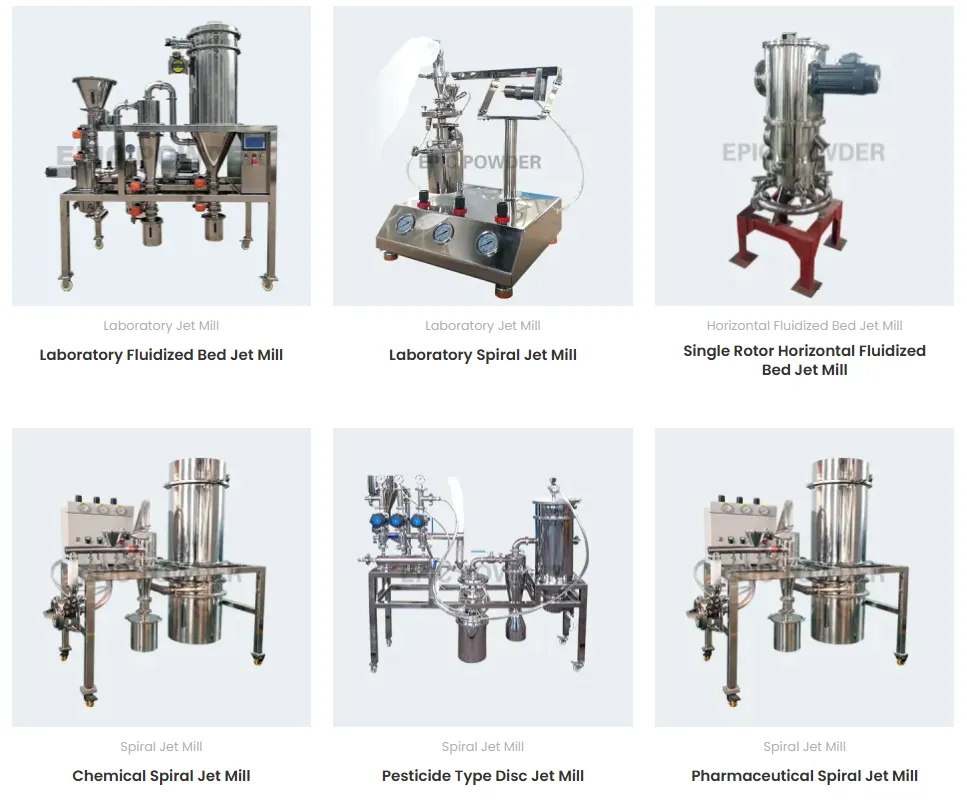
When selecting equipment, it’s essential to look beyond the initial price and consider long-term costs. Epic Powder’s jet mill has low energy consumption and minimal maintenance make it a more cost-effective choice in the long run. At Epic Powder, we offer a wide range of equipment models and tailor solutions to meet your specific needs.
Contact us today for a free consultation and customized solutions! Our expert team is dedicated to providing high-quality products and services to maximize the value of your powder processing.
Epic Powder—Your Trusted Powder Processing Expert!

“Thanks for reading. I hope my article helps. Please leave a comment down below. You may also contact EPIC Powder online customer representative Zelda for any further inquiries.
— Jason Wang, Senior Engineer